构建一次你的 Security Blueprint。在每个 OEM 项目群中复用它。
一个平台取代六个。你的 ECU 作为一个 Security Blueprint 存在于知识图谱上——模型、TARA、证据,全部相连。新的 OEM 项目群?克隆蓝图、重新绑定、分析增量:八成可直接沿用。你执行 one 个网络安全项目,而非四个。
●●● = how much this area matters to a Tier-1. Same platform, different job: the OEM view 刻意读起来不同。
DESIGN
建模一次,而非每个客户一次System Modeling — your Security Blueprint
●●●把 ECU 平台建模一次——那就是你的 Security Blueprint。下一个项目群从克隆它、分析增量开始,而不是从一张空白画布、旁边摆着另一家 OEM 的模板开始。
ARXML / System Composer / Simulink Ingest
●●●你的记录源本就是 System Composer 与 ARXML。ThreatZ 读取两个平面——网络与功能/行为——因此安全模型跟随设计,而非从设计中重敲。多数替代方案只读 ARXML,而它从不携带功能分解。
Diagnostic & Signal Ingest (ODX/PDX/CDD, DBC)
●●●你本就交付一个 ODX 文件。它成为 TARA 的资产清单——映射在提交前经过评审,绝不悄悄应用。
TARA
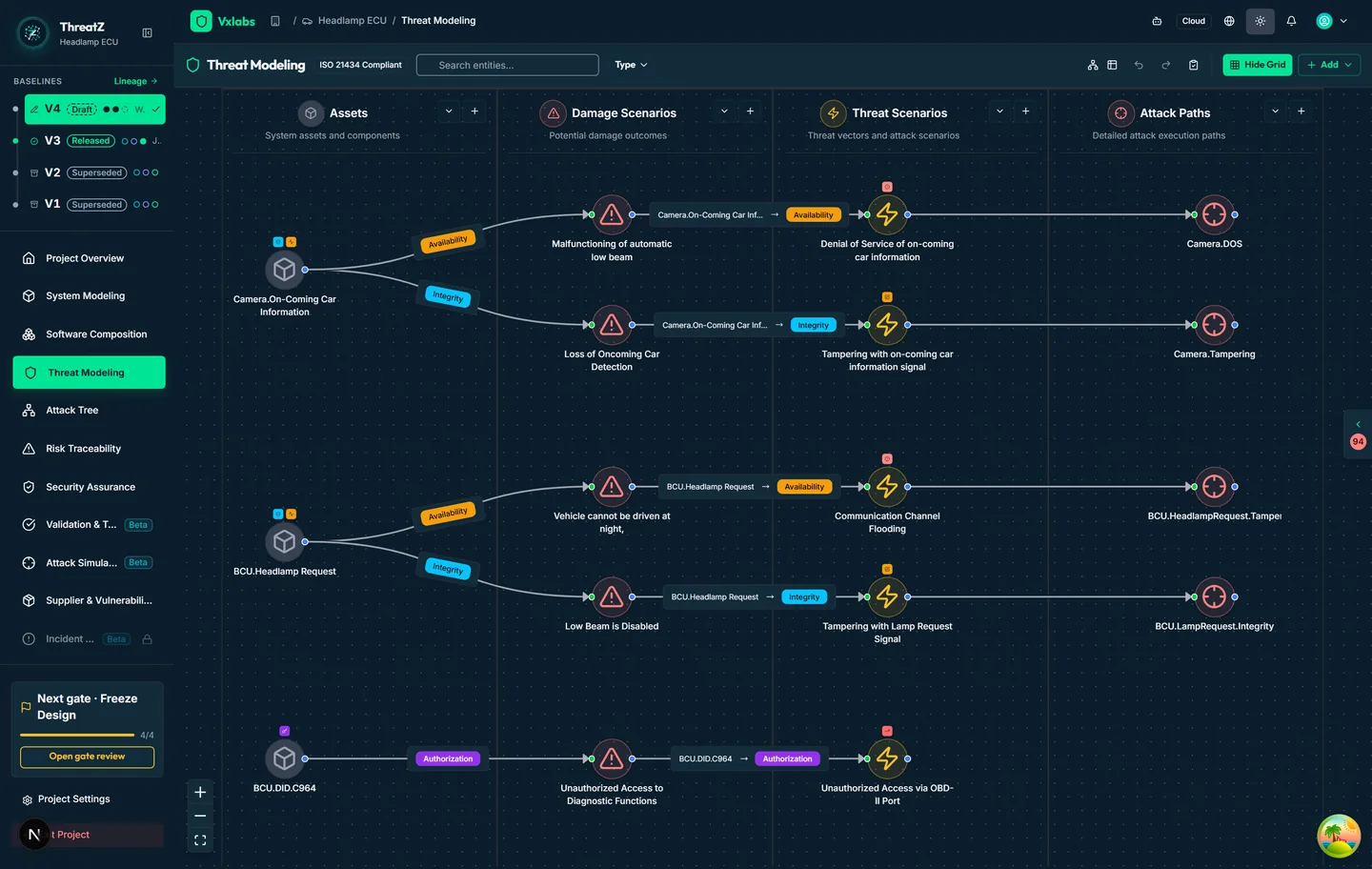
第十二个从第一个起步Threat Modeling
●●●同一 ECU 家族,十二个项目群,如今就是十二份 TARA。以图谱存储后,第十二个从第一个起步——你分析差异。第二个项目群 80% 复用;如今 60–70% 的工程师时间在重做已有工作。
Attack Path Analysis & Aggregated Attack Tree
●●●每家 OEM 都想按自己的方式评可行性。§15.7 的评级方法可按分析选择——攻击潜力、CVSS、攻击向量——都在同一批路径上。评一次,四种方式呈现。
Risk Assessment
●●●影响由你的客户决定,可行性由你决定。二者保持为独立输入,因此 OEM 可为其车辆情境重评影响,而不使你的工程分析失效。
Risk Treatment & Assurance Chain
●●●声明为你实际交付的内容作证,并指明共享风险落在你的二级供应商何处。ReqIF 导出意味着你的客户把它导入其需求工具,而不是再按其格式索要一次。
SBOM
四家 OEM,一个答案——还有你的二级供应商SBOM Management & Vulnerability Matching
●●●你一半的 CVE 工作是在追二级供应商,同时四家 OEM 以四种方式问同一个问题。联邦既向上也向下——你的二级供应商在你的租户里工作,正如你在客户的租户里工作。对客户的 CVE 响应时间,才是会变的那个数字。
TESTING
证据是副产品,而非冲刺Validation & Testing
●●●大部分验证证据由你产出。产出一次、相互关联、可跨项目群复用,正是审计冲刺与工作副产品之间的差别——如今每位 OEM 审计师一周,还要按各自的格式。
Penetration & Fuzz Campaigns
●●●测试预算有限,而每家 OEM 想要不同的深度。由评级路径驱动测试活动,让你能用分析来捍卫范围,而不是照单全收每个客户的要求。
COMPLIANCE
第二种格式只花一次渲染ISO/SAE 21434 Work Products & Report Templates
●●●一位审计师一周,然后又一位审计师一周,为的是同一份证据换个形态。由图谱生成,第二种格式只花一次渲染,而非一次重写。
Baselines, Variants & Releases
●●●这就是复用背后的机器。为新变体或客户项目群分叉基线,重新绑定,只分析有差异之处。这正是项目群 N+1 只花第一个的一小部分、而非从零开始的原因。
GOVERNANCE
他们的方法论,你的执行Policy Manager & Security Catalog
●●●Each customer's methodology arrives as policy you execute against, instead of six months of senior engineers reading template documents to learn how this OEM wants TARA done.
RBAC, audit trail & approval gates
●●●Multiple OEM programs in one tenant means one customer must never see another's work. Entity-level RBAC is what makes running them on one platform commercially safe.
COLLABORATION
one program, every customerSupplier Federation
●●●You stop running four cybersecurity programs in parallel and start executing one. Each customer's templates, methodology and cadence federate onto your platform — they see their workflow live, you work once. Portal adapters map data after the fact; federation happens before it.
Architecture Mapping Studio
●●●漏洞 → 组件 → 系统 → 测试证据,正是你的客户不断索要、却无人能快速产出的可追溯性。约 80% 的映射已为你提议好。
OPERATIONS
从你做分析所用的那张图谱作答Monitoring & Incidents
●●●现场事件以客户关于你 ECU 的提问形式到来。从你做 TARA 所用的同一张图谱作答,胜过每次重新拼凑上下文。
AI LAYER
把你先前的工作,反过来提议给你AI Assistant & Recommender
●●●推荐来自一张已保存你以往项目群的图谱,因此助手实际上是在把你自己先前的工作反过来提议给你。工程工时正是在这里被找回——而不是一个从未见过你架构的通用模型。
PLATFORM & DEPLOYMENT
在采购发问之前就作答Deployment, Sovereignty & Integrations
●●●你的客户会把他们的数据要求强加于你。在部署问题被提出之前就作答,能省去一轮否则会让你损失数周的采购流程。