Build your Security Blueprint once.Reuse it in every OEM program.
One platform replaces six. Your ECU lives as a Security Blueprint on the knowledge graph — model, TARA, evidence, all connected. New OEM program? Clone the blueprint, re-bind, analyse the delta: eighty percent carries forward. You execute one cybersecurity program, not four.
●●● = how much this area matters to a Tier-1. Same platform, different job: the OEM view reads differently on purpose.
DESIGN
model once, not once per customerSystem Modeling — your Security Blueprint
●●●Model the ECU platform once — that's your Security Blueprint. The next program starts by cloning it and analysing the delta, not from a blank canvas with a different OEM's template beside it.
ARXML / System Composer / Simulink Ingest
●●●Your source of record is already System Composer and ARXML. ThreatZ reads both planes — network and function/behaviour — so the security model tracks the design instead of being retyped from it. Most alternatives read ARXML only, which never carries functional decomposition.
Diagnostic & Signal Ingest (ODX/PDX/CDD, DBC)
●●●You already ship an ODX file. It becomes the asset inventory for the TARA — and the mapping is reviewed before commit, never applied silently.
TARA
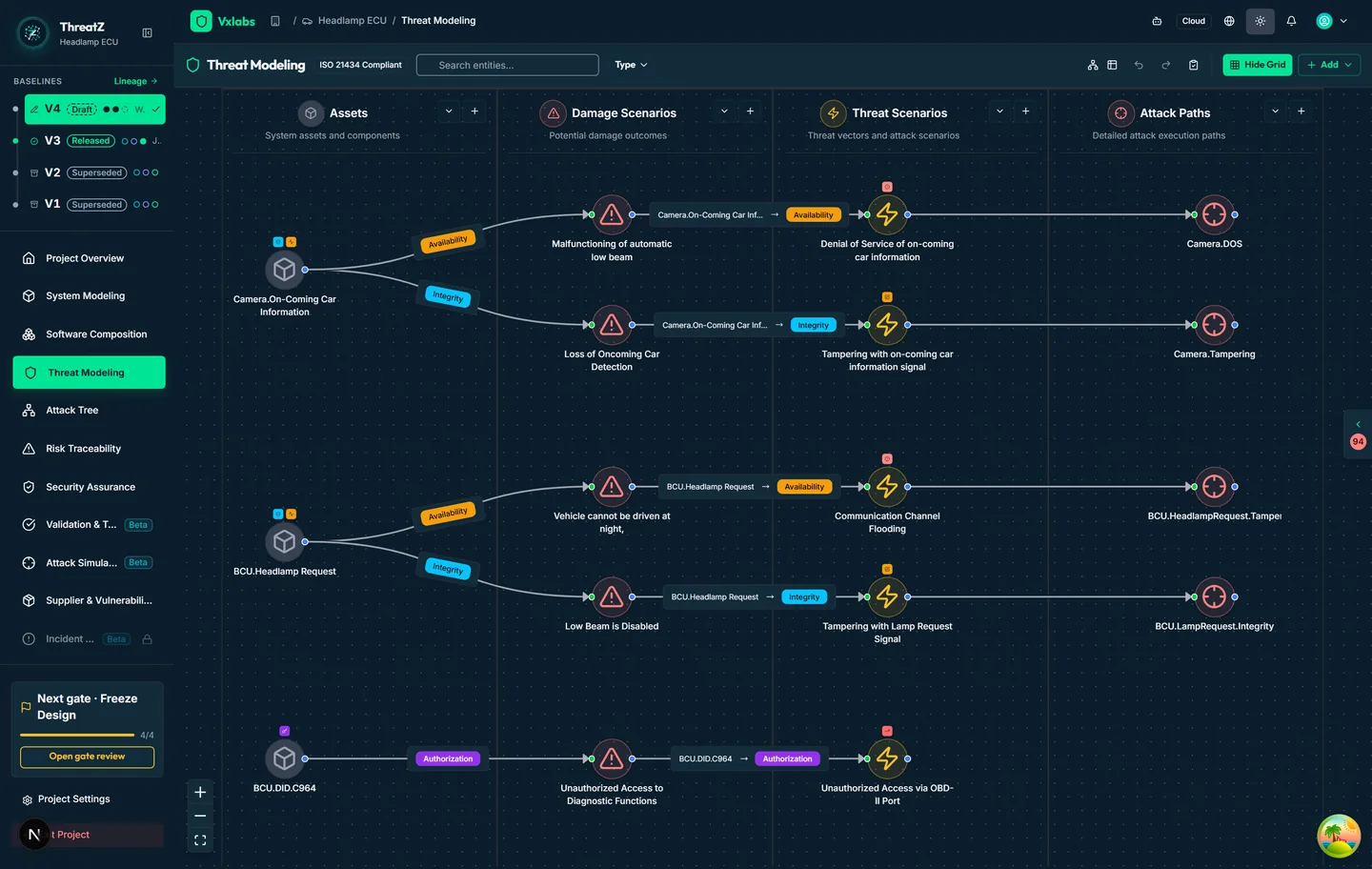
the twelfth starts from the firstThreat Modeling
●●●Same ECU family, twelve programs, twelve TARAs today. Stored as a graph, the twelfth starts from the first — you analyse the difference. 80% reuse on the second program; today 60–70% of engineer time is redoing existing work.
Attack Path Analysis & Aggregated Attack Tree
●●●Each OEM wants feasibility rated their way. The §15.7 rating approach is selectable per analysis — attack potential, CVSS, attack vector — over the same paths. Rate once, present four ways.
Risk Assessment
●●●Impact is your customer's call, feasibility is yours. They stay separate inputs, so an OEM can re-rate impact for their vehicle context without invalidating your engineering analysis.
Risk Treatment & Assurance Chain
●●●Claims evidence what you actually delivered, and where a shared risk sits with your Tier-2. ReqIF export means your customer ingests it into their requirements tool instead of asking for it again in their format.
SBOM
four OEMs, one answer — and your Tier-2sSBOM Management & Vulnerability Matching
●●●Half your CVE work is chasing Tier-2s while four OEMs ask the same question four ways. Federation runs downward as well as upward — your Tier-2s work in your tenant the way you work in your customer's. CVE response time to customers is the number that moves.
TESTING
evidence as a byproduct, not a sprintValidation & Testing
●●●You produce most of the verification evidence. Producing it once, linked and reusable across programs is the difference between an audit sprint and a byproduct of the work — today it's a week per OEM auditor, in each auditor's format.
Penetration & Fuzz Campaigns
●●●Test budget is finite and every OEM wants a different depth. Driving campaigns from rated paths lets you defend scope with the analysis instead of absorbing whatever each customer asks for.
COMPLIANCE
the second format costs a renderISO/SAE 21434 Work Products & Report Templates
●●●One auditor's week, then another auditor's week for the same evidence in a different shape. Generated from the graph, the second format costs a render, not a rewrite.
Baselines, Variants & Releases
●●●This is the machinery behind reuse. Fork the baseline for the new variant or customer program, re-bind, analyse only what differs. It's why program N+1 costs a fraction of the first instead of starting at zero.
GOVERNANCE
their methodology, your executionPolicy Manager & Security Catalog
●●●Each customer's methodology arrives as policy you execute against, instead of six months of senior engineers reading template documents to learn how this OEM wants TARA done.
RBAC, audit trail & approval gates
●●●Multiple OEM programs in one tenant means one customer must never see another's work. Entity-level RBAC is what makes running them on one platform commercially safe.
COLLABORATION
one program, every customerSupplier Federation
●●●You stop running four cybersecurity programs in parallel and start executing one. Each customer's templates, methodology and cadence federate onto your platform — they see their workflow live, you work once. Portal adapters map data after the fact; federation happens before it.
Architecture Mapping Studio
●●●Vulnerability → component → system → test evidence is the traceability your customers keep asking for and nobody produces quickly. ~80% of the mapping is proposed for you.
OPERATIONS
answer from the graph you analysed inMonitoring & Incidents
●●●Field incidents arrive as your customer's questions about your ECU. Answering from the same graph you did the TARA in beats reconstructing the context each time.
AI LAYER
your prior work, proposed back to youAI Assistant & Recommender
●●●Recommendations come from a graph that already holds your previous programs, so the assistant is effectively proposing your own prior work back to you. That's where the engineering hours are recovered — not a general-purpose model that has never seen your architecture.
PLATFORM & DEPLOYMENT
answer procurement before it asksDeployment, Sovereignty & Integrations
●●●Your customers will impose their data requirements on you. Answering the deployment question before it's asked removes a procurement round you'd otherwise lose weeks to.
Program N+1 shouldn't
cost what program 1 did.
Bring your ECU family and your customer list — we'll show the reuse math on your own shape.
Book a Tier-1 demo